
How Bench Warrants Work in Adams County
An Adams County bench warrant starts with an existing court duty. Colorado Rule of Criminal Procedure 4 allows a judge to issue a bench warrant when a person does not appear or pay as required by a summons or penalty assessment. A missed hearing, an unmet payment term, or failure to follow another order may bring the case back before the judge. Colorado sources use the terms “bench warrant” and “warrant for arrest.” Capias pro fine is not the normal label in these Adams County records.
The warrant authorizes arrest, yet it does not decide guilt on the underlying matter. A city judge may issue one in a municipal traffic or code case. Adams County Court handles traffic, misdemeanor, and county-level matters, while the Colorado District Court in the 17th Judicial District handles felony and other district-level cases. The case setting and court named in the record determine which clerk can explain the available recall, bond, or appearance route.
Adams County Bench Warrant Checks
The official Adams County Sheriff warrant search is the first broad check. It accepts first name, last name, date of birth, and warrant number. The Sheriff states that the list covers warrants held by that office, omits juveniles, and updates daily by 7 a.m. A missing result does not prove that no Adams County bench warrant exists.
Call the ACSO Warrants Section at 720-322-1325 on weekdays from 8 a.m. to 5 p.m. to confirm a result and ask which court issued it. For a state case, the Colorado Judicial Docket Search may supply a case number, hearing date, and court context, but it is not a statewide warrant database or the official file. A city ticket or ordinance case should also be checked with the named municipal court. Written requests may go to recordsrequest@adamssheriffco.gov for sheriff records or AdamsRecordRequest@judicial.state.co.us for state-court records.
Note: Search results are leads for confirmation, not legal proof that an Adams County bench warrant is active or cleared.
Bench Warrant Issuance in Adams County
The court first has a case, summons, citation, or order tied to the person. If the person misses the set date or does not comply, the judge or magistrate may enter a bench warrant. The sequence is simple: required appearance or payment → failure to appear or comply → judicial order → warrant entry → service or court recall. The sheriff does not create the court order merely because it later appears in the ACSO system.
Municipal judges follow their city case rules, and state judges work within the 17th Judicial District. That split matters. A bench warrant held by Thornton Municipal Court may have different walk-in and bond terms than one from Adams County Court. An ACSO entry can help route the person, but the issuing court controls whether the order is recalled or quashed. “Quashed” means canceled by judicial action. A clerk can confirm whether a motion, bond, reset, or personal appearance is needed.
Thornton Bench Warrant Walk-Ins
Thornton Municipal Court publishes a direct option for an active municipal bench warrant. The person may walk in Monday, Tuesday, or Thursday from 8 to 10 a.m. The court states that a person may be seen by video or transported to court and may have a chance to post bond. Its bond rules allow cash or surety, not personal checks.
The official Thornton court contact page shows the local court setting used for this process.
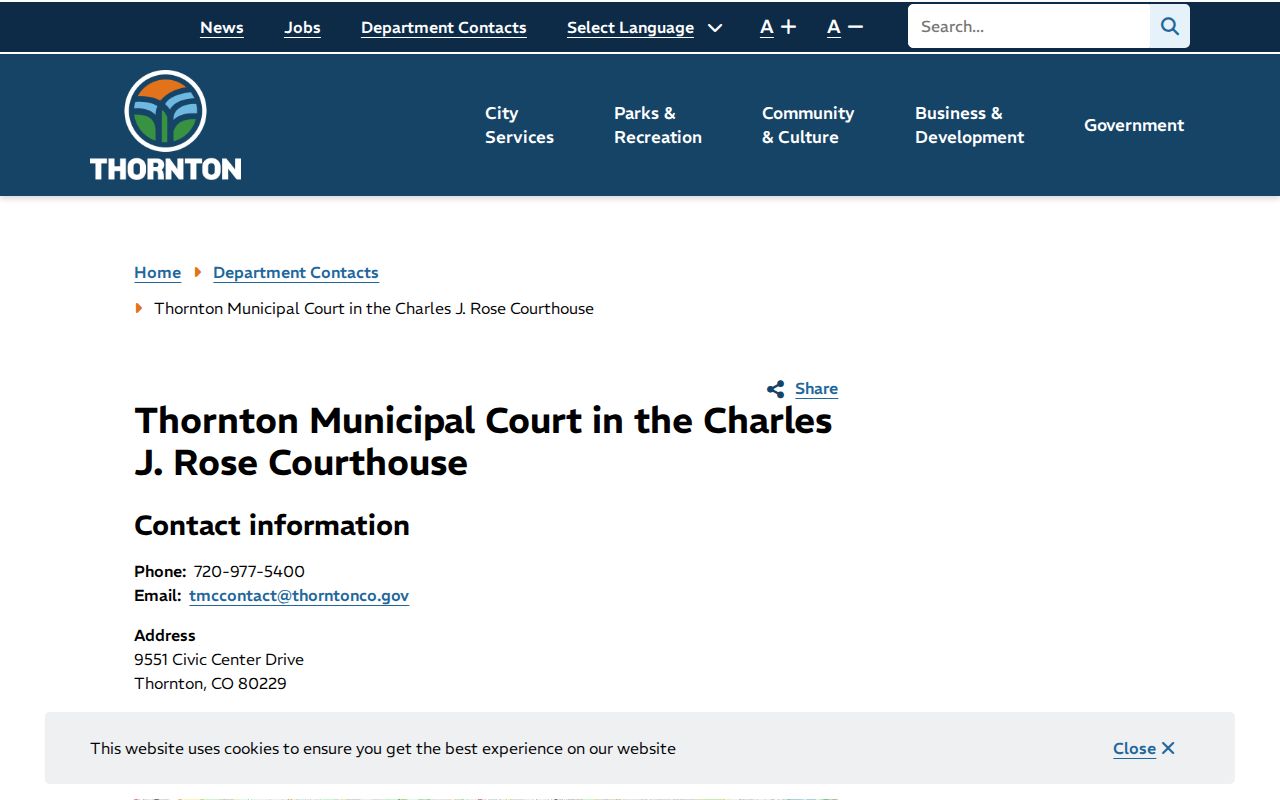
The image helps distinguish the municipal court from the Adams County Justice Center. A person should call Thornton at 720-977-5400 before relying on an old setting or assuming that a walk-in guarantees release.
The official Thornton payment page also documents the court's payment and late-payment instructions.
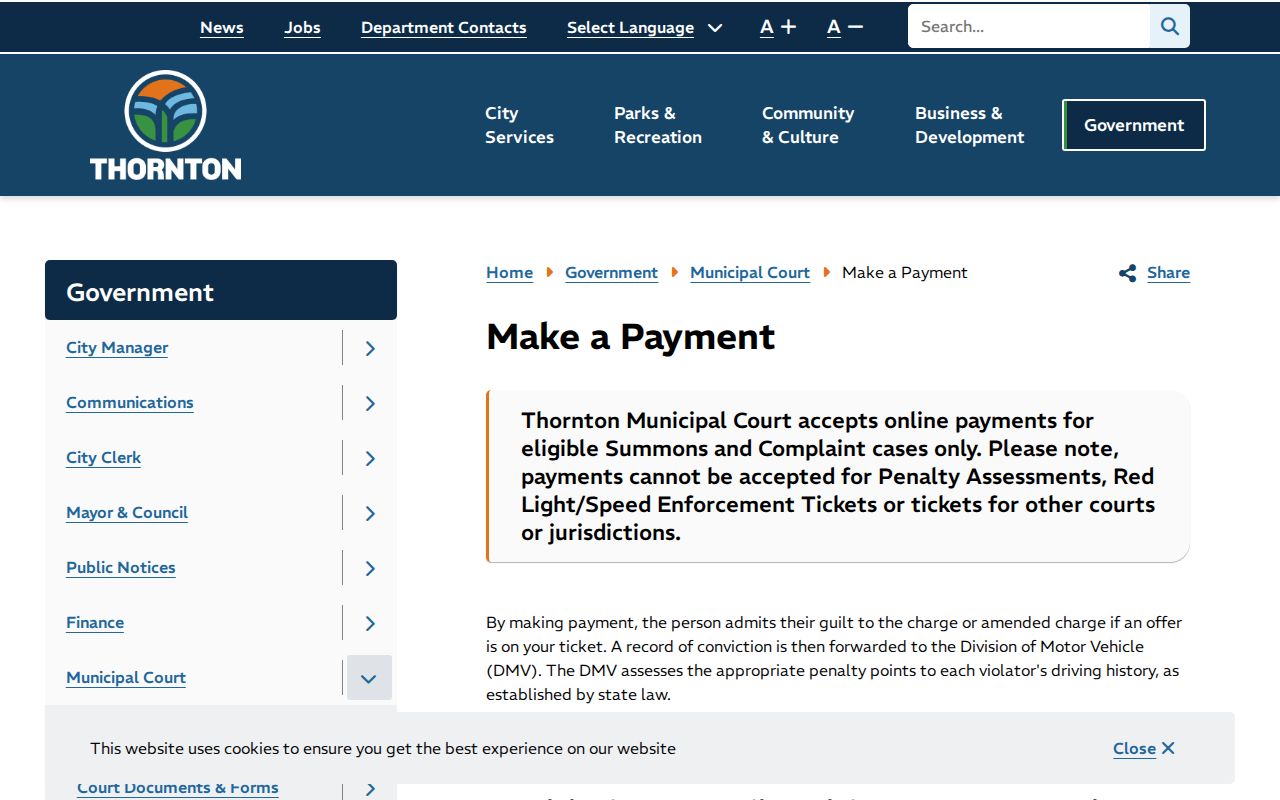
This capture shows why eligibility must be checked before acting. A mandatory appearance cannot be replaced by online payment, and payment does not recall a bench warrant until the court records the proper action.
How Bench and Arrest Warrants Differ
A bench warrant grows out of a missed duty in an existing case. An arrest warrant rests on facts presented to a judge that establish probable cause for an offense. Both can authorize custody, but their source and response paths differ. The distinction also affects the record a reader should request. A bench record points back to the skipped setting or order, while an arrest-warrant file may include a sworn affidavit and charge information.
| Feature | Bench Warrant | Arrest Warrant |
|---|---|---|
| Trigger | Missed court, payment, or ordered step | Probable cause that an offense occurred |
| Who Issues It | Judge or magistrate in the case | Judge or magistrate after sworn facts |
| Underlying Case | Usually an existing case | May begin a new criminal case |
| Next Step | Appearance, motion, bond, recall, or quash | Surrender, booking, bond review, and court |
Adams County City Court Routes
Several Adams County municipal courts publish their own bench-warrant routes. Westminster tells a person to call 303-658-2250 and offers surrender Monday and Tuesday from 7:30 to 9 a.m.; a person may instead post the stated bond at the front counter for a new date. Commerce City directs a missed-date defendant to call 303-289-3640 or email court1@c3gov.com and permits a walk-in at a scheduled court date.
Brighton allows cash or professional surety bond for a new setting, with a $20 processing fee, or a walk-in at a scheduled 8 a.m. or 1 p.m. court time to ask the judge to quash the Adams County bench warrant. Northglenn publishes a general motion form that may begin a request for relief, but its clerk at 303-450-8701 should confirm the current warrant process. These routes are not interchangeable. Use the court printed on the citation or case record.
Clearing a Bench Warrant in Adams County
Resolution starts with verified status and the issuing court. Filing a motion does not by itself stop service. Posting bond usually deals with custody and creates a later date; it does not end the charge. A person with a felony, domestic-violence, probation, immigration, or out-of-county issue should speak with counsel before appearing.
- Confirm the Adams County bench warrant with ACSO and record the warrant number, case number, and issuing court.
- Ask the clerk or counsel whether the court accepts a motion, bond, reset, surrender, or walk-in appearance.
- Use only the issuing court's stated process and bring the case or citation number plus identification.
- After the judge acts, confirm the court entry and then recheck any sheriff record for the updated status.
Caution: A payment, motion, or bond does not clear an Adams County bench warrant until the issuing court records the proper action.
Bond Does Not End the Case
A common mistake is to treat bond as a final resolution. The judge chooses the bond type, which may be cash, surety, personal recognizance, or another lawful form. ACSO accepts cash, money order, or cashier’s check for an inmate bond at the Brighton detention facility and links an online AllPaid option. Money orders and cashier’s checks should be payable to the Clerk of the Court. Bond questions may be directed to 303-654-1850.
Bond secures a later appearance. The underlying Adams County case remains open, and missing the new date can lead to forfeiture and another warrant. A municipal court may publish narrower rules. Brighton adds a processing fee and does not accept credit cards for its warrant bond, while Thornton accepts cash or surety. Confirm the amount, form of payment, and next date with the issuing court before funds change hands.
Note: The judge, not the sheriff search page, sets or changes bond and controls the Adams County bench warrant recall.
Adams County Courts That Issue Bench Warrants
The Colorado Judicial Branch Clerk of Court keeps the state District and County Court files. The elected Adams County Clerk & Recorder does not keep state criminal case records. Adams County Court covers state traffic, misdemeanors, and county-level criminal matters. The Colorado District Court, 17th Judicial District, handles felony and other district-level cases. Municipal courts handle local traffic, parking, animal, code, and ordinance matters.
Start with the warrant record, citation, or docket case number. Select Judicial District 17, Adams County, the Adams County Justice Center, and the proper court type in the state docket tool when seeking state-case context. For a city case, call that municipal clerk. If no office can confirm the source, narrow a written request to the person’s own name, date of birth, and known case or warrant number. The full Adams County warrant records overview provides the countywide agency path.
Confirm an Adams County Recall
A court can recall or quash a bench warrant after an appearance, motion, bond, reset, or other approved step. The exact result should appear in the court file. Web systems may lag. Ask the clerk for the date and nature of the judge’s action, the next court date, any balance or condition that remains, and when the updated status should reach ACSO.
The 17th Judicial District Collections Unit accepts court payments in person, by mail, or online, but not by phone. A payment must include the name and case number. Still, payment alone may not be the remedy when an appearance is mandatory. Keep the court receipt or filed order, then call ACSO if the public entry does not update. That two-step check prevents an online lag from being mistaken for a new Adams County bench warrant.
Fresh Start offers a limited option for some low-level Adams County warrants. The county Criminal Justice Coordinating Council reported that the 2023 event served 82 participants and resolved 102 warrants. Eligibility is not universal, and the 2026 event has ended. The council says the program will return in 2027 with dates announced in spring. A person should not wait while an order remains active. Check the official program and keep following the issuing court's instructions.
Program results are not a count of all outstanding warrants in Adams County. They show why court-by-court checks remain necessary. The oldest warrant resolved in that report dated to 2003, while most involved more recent failures to appear. Northglenn, Brighton, Commerce City, and Broomfield municipal courts took part. Each participating court still determined relief in its own cases. A future applicant must meet the published rules and should confirm whether their charge, warrant type, and court are included before relying on the event.
A relative helping with the process should first obtain the person's consent and exact case details. Write down the full court name, case number, warrant number, and next date. Then call the clerk, not a payment vendor, to ask what the judge requires. If a bond or fee is quoted, confirm the accepted form of payment and payee. After any appearance, motion, or payment, ask for a copy of the order or docket entry. These small steps make it much easier to trace an Adams County bench warrant across the court and sheriff systems.
The public record may use short status terms. “FTA” means failure to appear. “Recall” means the court withdrew the warrant. “Quash” means judicial cancellation. “Bond forfeiture” means the court may keep or claim the bond after a missed date. None of these terms should be guessed from a blank search result. The clerk can explain the current entry and identify whether the underlying case still needs a plea, hearing, payment plan, or trial setting.
Written records requests can fill a gap when the web list and court response do not align. The ACSO form asks for a focused description and delivery choice. Its policy gives a three-business-day target for many requests and allows more time in stated conditions. A fee estimate or deposit may apply. For a state case, use the Judicial Branch court-record address rather than the county administrative CORA form. For a city case, send the request to that municipal court.
Bench-warrant procedures also vary by how the case began. A traffic summons may permit a payment or walk-in option. A misdemeanor case may require bond and a new appearance. A District Court matter may call for counsel and a formal motion. The warrant number alone does not reveal every term. Read the case docket, ask which judge or division controls the file, and confirm whether the person must appear in person. Never assume a city policy applies to Adams County Court.
If counsel files a motion to recall or quash, ask whether the court has ruled and whether a hearing is set. Filing is only a request. It does not automatically suspend the warrant. A signed order or docket entry is the key proof of judicial action. Once the court acts, verify that bond was handled and that the next date is clear. Then contact ACSO to determine when its daily public list should reflect the court's decision.
A city case can also carry a payment vendor entry that looks current while the warrant status remains unchanged. The court clerk must connect the payment or appearance to the judicial record. Ask for the date of recall, the new setting, and any remaining balance. If the clerk says an update was sent to ACSO, allow for the stated daily refresh and then confirm again by phone. This final check is especially useful when a Thornton, Westminster, Brighton, Commerce City, or Northglenn case appears differently across local and county channels.
Keep copies of the summons, motion, receipt, bond record, and court order. Those papers help the issuing court trace the case if a name or warrant number was entered incorrectly. They also show which obligation remains. The record should be used to solve the person's own court problem, not to draw conclusions about guilt from an active status.